Understanding Contracts in Plain English
Lesson: The Small Print: Understanding Contracts in Plain English
This is a lesson I teach to people who read, sign or explain contracts in English, from legal teams to business owners. Together we learn key words like clause, binding and loophole, and practise talking about contract terms in plain English.
In short: the key language in this lesson
Useful phrases
- Comparing different views about contracts: Some people say ___, but I think ___ because ___.
- Weighing up pros and cons of a contract or deal: The advantage of ___ is ___, but the disadvantage is that ___.
- Imagining a situation with contracts (hypothetical): If I ___ before signing, I would probably ___ because ___.
Key words
- clause:
- one part of a written agreement that deals with a single point
- binding:
- if an agreement is binding, you must follow it
- loophole:
- a weakness in a rule that lets you avoid it
- negotiate:
- to talk with someone to reach an agreement both sides accept
- obligation:
- something you must do because of a rule, law or promise
Idioms and phrasal verbs
- be in a hurry:
- moving or acting fast because you don't have much time
- push back on:
- to resist or complain about something to try to change it
- sign up for:
- to agree to join or start something, like a service or course
- the small print:
- the detailed rules in a contract, often written small and easy to miss
This lesson is designed to be taught live, not studied alone. I create every lesson and teach it myself, one-to-one. In class, I guide you through each part, ask follow-up questions, correct your mistakes and help you say more.
Here you can see exactly what a lesson with me looks like. For my students, I build lessons like this around their own job and goals.
1 Warm-up
Look at the questions below and talk about your own experiences with contracts and agreements — big or small.
We start with a relaxed chat. I ask these questions, you answer freely, and I note useful language for later.
- When was the last time you signed a contract or agreement? What was it for?
- Do you usually read everything before you sign, or do you just sign and hope for the best?
- Have you ever been surprised by something in the small print after signing?
- Do you think most people understand the contracts they sign? Why or why not?
- If you could change one thing about how contracts are written, what would it be?
2 Key vocabulary
Before the reading, we go through 5 key words together: how to say them, what they mean, and how people really use them.
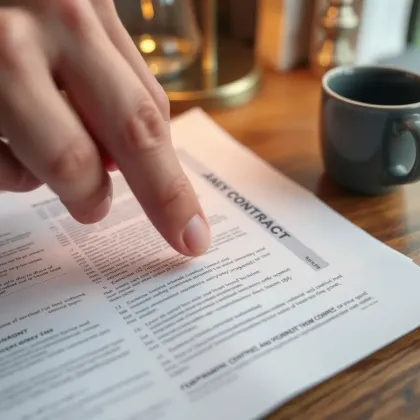
clause noun
Pronunciation: /KLAWZ/
one part of a written agreement that deals with a single point
- There's a clause in my rental contract about who pays for repairs.
- The contract has a clause that says you can't have pets.
- Lawyers spent hours arguing about one clause.
- I always check the cancellation clause before I sign anything.
Common phrases a hidden clauseread the clauses carefullya clause about payments
Word family clauses (plural)
How to use it: Use 'clause' for any separate section of a contract or official agreement. It's more precise than 'part' and sounds natural in work and everyday legal talk.
- Similar
- section, paragraph, term
- Opposite
- the whole document
- Often used in
- rental agreements, job contracts, insurance policies

binding adjective
Pronunciation: /BIN-ding/
if an agreement is binding, you must follow it
- Once you sign, the contract is binding — you can't just change your mind.
- A verbal agreement can even be binding in some countries.
- The deal only became binding after both companies signed.
- Is a promise made by email legally binding?
Common phrases a binding agreementlegally bindingbinding on both sides
Word family bind (verb)bound (past form)
How to use it: Often used with 'legally'. Use it to describe agreements, promises or decisions that you cannot ignore without consequences.
- Similar
- official, enforceable, final
- Opposite
- optional, non-binding, informal
- Often used in
- business deals, court decisions, signed contracts

loophole noun
Pronunciation: /LOOP-hohl/
a weakness in a rule that lets you avoid it
- Companies found a loophole in the tax law and paid almost nothing.
- There's a loophole in the contract — it doesn't say anything about weekends.
- The government closed the loophole last year.
- He escaped the fine by finding a clever loophole.
Common phrases find a loopholeclose a loopholeslip through a loophole
Word family loopholes (plural)
How to use it: Often suggests someone cleverly using a mistake or gap. Neutral in grammar, but can sound slightly sneaky depending on tone.
- Similar
- gap, escape route, weakness
- Opposite
- airtight rule, closed door
- Often used in
- taxes, contracts, sports rules

negotiate verb
Pronunciation: /nuh-GOH-see-ayt/
to talk with someone to reach an agreement both sides accept
- She negotiated a lower price for the apartment before signing.
- You can negotiate the terms of a job offer — many people don't try.
- The two countries negotiated for months.
- I negotiated with the seller and got ten percent off.
Common phrases negotiate a dealnegotiate the termsnegotiate with someone
Word family negotiation (noun)negotiator (person)negotiable (adjective)
How to use it: Both sides give something and get something. Use it for prices, salaries, contracts and deals — not for one-sided orders.
- Similar
- bargain, discuss terms, make a deal
- Opposite
- accept without question, dictate
- Often used in
- job offers, markets, business contracts

obligation noun
Pronunciation: /ob-luh-GAY-shun/
something you must do because of a rule, law or promise
- Paying rent is a legal obligation for anyone who signs a lease.
- Parents have an obligation to look after their children.
- I felt an obligation to help after all she'd done for me.
- The company failed to meet its obligations to workers.
Common phrases a legal obligationfeel an obligationmeet your obligations
Word family obliged (adjective)obligatory (adjective)
How to use it: Stronger than 'duty' in everyday talk and often connected to contracts, laws or promises. Can be legal or personal ('I felt obliged to...').
- Similar
- duty, responsibility, commitment
- Opposite
- choice, option, freedom
- Often used in
- work, family life, rental agreements
3 Reading
A short true-to-life story about what can happen when we sign without reading. As you read, notice the five new words in action.
In class, you read the text aloud. I help with pronunciation and natural rhythm, and then we talk about it.
Maya and the Phone Contract
Last month, Maya signed a contract for a new phone. She was excited and only checked the price. Weeks later, she found a clause that surprised her: if she cancelled early, she had to pay for the whole year. 'The words were long and I was in a hurry,' she admits.
Her story is common. Many people sign agreements without really reading them. But a contract is binding: once you sign, you must follow it, even the parts you missed. Maya now had an obligation to pay for eleven more months, and she was not happy about it.
Then a friend spotted a loophole: the company had written the wrong date on page one. Because of that small mistake, the deal was not fully binding. Maya called, negotiated, and agreed to pay only three more months. Both sides were satisfied.
Stories like this explain why some countries now want contracts in plain English: short sentences, everyday words, and a clear heading for each clause. If people understand what they sign, they can negotiate changes or ask questions before it is too late.
Not everyone agrees. Some lawyers say certain details must stay exact, or the meaning changes. Others warn that simple language could open a loophole for dishonest companies. Either way, signing creates an obligation, and most of us will do it this year — a job contract, a rental agreement, a phone plan. Will you read yours?
4 Comprehension
We check what you understood from the reading. You explain your answer in your own words. (The answers are under each question.)
-
What does 'clause' mean?
Show answer
One part of a written agreement that deals with a single point
A clause is one section of a contract covering one topic, like payment or cancellation.
-
Which sentence uses 'binding' correctly?
Show answer
Once you sign, the contract is binding and you must follow it.
'Binding' is an adjective describing an agreement you cannot ignore. The other sentences use it as a noun or verb incorrectly.
-
In which situation would you use the word 'loophole'?
Show answer
When you want to describe a weakness in a rule that lets someone avoid it
A loophole is a gap or mistake in a rule or contract that people can use to get around it.
-
What does 'negotiate' mean?
Show answer
To discuss with someone in order to reach an agreement
Negotiating means talking back and forth until both sides accept the deal.
-
In which situation would you use the word 'obligation'?
Show answer
When you describe something you must do because of a rule or promise
An obligation is a duty — something required by a law, contract or promise, not something you choose.
5 Idioms and phrasal verbs
You find each expression in the reading and guess what it means. Then we practise using it to talk about your own life and work.
be in a hurry
From the reading'The words were long and I was in a hurry,' she admits.
What do you think it means? Show meaning
moving or acting fast because you don't have much time (similar: rushed)
Example: I was in a hurry this morning, so I skipped breakfast.
- Usually with 'in': 'in a hurry'. You can also say 'in no hurry' to mean you're relaxed about it. ✓ I was in a hurry ✗ I was on a hurry
Your turn: When was the last time you signed or agreed to something in a hurry? What happened?
push back on
What do you think it means? Show meaning
to resist or complain about something to try to change it (similar: object to)
Example: She pushed back on the extra weekend hours and her boss agreed to change them.
- The small word 'on' shows what you're resisting: push back ON a rule, a price, a deadline.
- Common at work, especially about salaries and conditions. Slightly informal but fine in meetings.
Your turn: Have you ever pushed back on something at work or school? Did it work?
sign up for
What do you think it means? Show meaning
to agree to join or start something, like a service or course (similar: register for)
Example: I signed up for a gym membership in January and never went again.
- Can be split: 'sign up for a plan' or 'sign up for it'. Never 'sign it up for'.
- Often used for subscriptions and free trials — perfect for talking about contracts.
Your turn: What's something you signed up for and later regretted?
the small print
What do you think it means? Show meaning
the detailed rules in a contract, often written small and easy to miss (similar: the details)
Example: Check the small print before you accept — that's where they hide the fees.
- The picture: important conditions literally printed in tiny letters at the bottom of a page.
- British English; Americans usually say 'the fine print', which means the same thing.
Your turn: Do you usually read the small print? What's the worst thing you've found hiding there?
6 Sentence frames
Practice expressing ideas about contracts, deals and duties.
We start with the simple frame and step up to longer, more natural sentences. You fill the gaps with your own ideas, and I help you sound more fluent.
Comparing different views about contracts
Grammar contrast connectors (but, while)giving reasons with because
-
Simple
Some people say ___, but I think ___.
State the other view, then your own. Keep it short and clear.
Example answers
- Some people say contracts are boring, but I think they're important.
- Some people say lawyers write contracts, but I think anyone can understand the basics.
- Some people say signing fast is fine, but I think reading first is better.
-
Stronger
Some people say ___, but I think ___ because ___.
Add a reason to support your opinion.
Example answers
- Some people say simple contracts are better, but I think exact words matter because small changes can alter the meaning.
- Some people say you should never sign quickly, but I think it depends because some contracts are genuinely simple.
- Some people say loopholes are unfair, but I think they're just clever because the rules allow them.
Weighing up pros and cons of a contract or deal
Grammar advantage/disadvantage languageconcessive 'but'
-
Simple
The good thing about ___ is ___. The bad thing is ___.
One plus, one minus. Simple and balanced.
Example answers
- The good thing about a long contract is a lower price. The bad thing is you're stuck.
- The good thing about plain English is it's easy. The bad thing is it might miss details.
- The good thing about negotiating is a better deal. The bad thing is it takes time.
-
Stronger
The advantage of ___ is ___, but the disadvantage is that ___.
Slightly more formal weighing of both sides.
Example answers
- The advantage of a binding contract is security, but the disadvantage is that you can't change your mind easily.
- The advantage of simple language is clarity, but the disadvantage is that important details might get lost.
- The advantage of reading every clause is safety, but the disadvantage is that it takes ages.
Imagining a situation with contracts (hypothetical)
Grammar second conditionalwould for hypothetical results
-
Simple
If I found ___, I would ___.
Simple if + would. One condition, one result.
Example answers
- If I found a loophole, I would use it.
- If I found a hidden clause, I would call the company.
- If I didn't understand a contract, I would ask a friend.
-
Stronger
If I ___ before signing, I would probably ___ because ___.
Add a reason to the hypothetical result.
Example answers
- If I read the small print before signing, I would probably avoid surprises because that's where they hide.
- If I found a mistake in the contract, I would probably negotiate a better deal because it gives me power.
- If I felt pressured to sign quickly, I would probably walk away because pressure is a bad sign.
7 Fill in the blanks
A quick practice with the new words: you choose the right word for each gap.
Word box clausebindingloopholenegotiateobligation
When my brother rented his first flat, the agent told him signing was just a formality. But the paper said he had an 1 to pay the full year, even if he moved out early. Luckily, a friend checked the document and found a 2: the landlord had forgotten to sign one page, so the deal was not 3. There was also a 4 about repairs that seemed unfair, so my brother decided to 5 before signing anything. In the end, the landlord agreed to fix the heating, and everyone was happy.
Show answers
- obligation
- loophole
- binding
- clause
- negotiate
8 Sentence unscramble
You put the words in order and say the sentence out loud.
-
clauseeverysignayouReadcontract.before
Show answer
Read every clause before you sign a contract.
-
loopholecanwholeagreement.Achangesmallthe
Show answer
A small loophole can change the whole agreement.
-
withdealnegotiatedShebettertheaphonecompany.
Show answer
She negotiated a better deal with the phone company.
9 Discussion
The main speaking part of the lesson. We discuss each question together, and you use the new words and sentence frames. I ask follow-up questions and correct your mistakes as we go.
-

Most adults sign something every year — a phone plan, a rental agreement, an insurance policy, a job contract. These papers are often long, and the small print is famous for hiding surprises. Some people read every word; others just sign and move on.
Think about the last thing you signed. Did you actually read it all? What made you sign the way you did?
-

There's a growing movement to write contracts in plain English: short sentences, everyday words, clear headings. Supporters say everyone deserves to understand what they're signing. Critics say legal language exists for a reason — one wrong word can change the whole meaning.
Which side are you closer to: simple language for everyone, or exact legal words even if they're hard? Why?
-
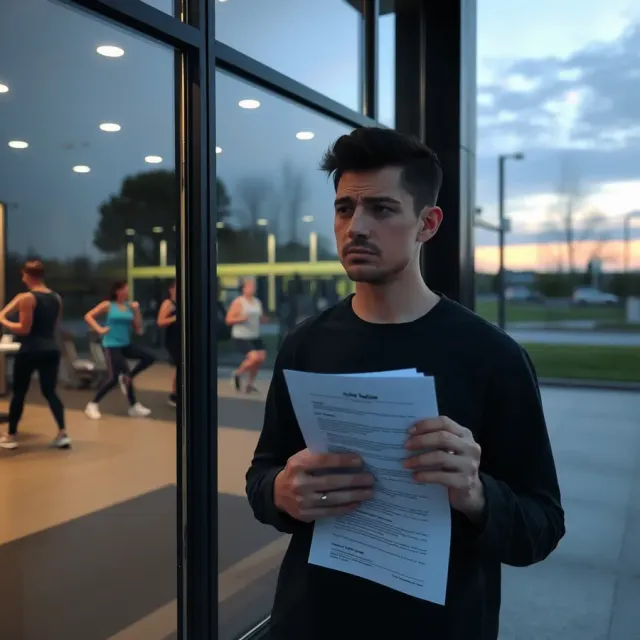
Imagine you've signed a one-year gym membership. A few months in, you discover a mistake in the contract — a missing date — that means you could legally stop paying. The gym never noticed the error.
Would you use that loophole and stop paying, or keep paying anyway? Where's the line between clever and unfair?
-

In some cultures, negotiating prices or conditions is completely normal — at markets, with landlords, even for salaries. In others, people accept the first offer because negotiating feels uncomfortable or even rude. Contracts are one place where negotiating can really pay off.
Have you ever negotiated anything — a price, a salary, a deal? How did it go, and would you try it with a contract?
-

Job contracts often include obligations: working certain hours, giving notice before leaving, keeping company information private. Some obligations feel reasonable; others can feel one-sided, especially for people new to a job or a country.
What obligations would you accept happily in a job contract, and what would you push back on before signing?
10 Quiz
A short review at the end of the lesson to check what you remember.
-
What is a 'clause' in a contract?
Show answer
One part of the agreement that covers a single point
A clause is a single section of a contract dealing with one topic, like payment or cancellation.
-
True or false: a binding contract is one you can ignore whenever you want.
Show answer
False
It's the opposite — a binding contract is one you must follow once you've agreed to it.
-
If you find a loophole in a contract, you have found...
Show answer
a weakness that lets you avoid part of the agreement
A loophole is a gap or weakness in a rule that someone can use to get around it.
-
True or false: negotiating means discussing with someone to try to reach an agreement.
Show answer
True
Negotiating is exactly that — a back-and-forth discussion aimed at a deal both sides can accept.
-
An 'obligation' is best described as...
Show answer
something you must do because of a rule, law or promise
An obligation is a duty — the opposite of a free choice.
-
If you "push back on" a rule at work, what do you do?
Show answer
You resist it and try to get it changed
"Push back on" means to resist something or complain about it because you want it to change.
Lesson created with PlanwiseESL.
Useful for: English for legal professionals
More sample lessons
Handling Questions After a Presentation
How to answer questions after a presentation or conference talk in English: clarify, rephrase, acknowledge a fair point. A B2 lesson I teach one-to-one.
See the lesson → Level B2Talking About Career Goals and Leadership in an Interview
Words to talk about your goals and leadership in a job or scholarship interview: aspiration, track record, initiative. A B2 lesson I teach one-to-one.
See the lesson → Level B2The Great Game: How Countries Compete for Power
Learn words to talk about geopolitics in English: alliance, sanctions, sovereignty, superpower and more. A B2 discussion lesson I teach live, one-to-one.
See the lesson →All sample lessons: What British Colleagues Really Mean: Polite, Indirect English at Work · Vocabulary to Talk About AI in English · Business Small Talk in English · How to Disagree Diplomatically in English · Talk About the Pros and Cons of International Aid in English · How to Stop Translating in Your Head When You Speak English · Words to Describe Inequality in English · Health and Fitness Vocabulary in English · Vocabulary to Talk About Films in English · Vocabulary to Talk About Money in English · Vocabulary to Talk About the Environment in English · Words to Describe a Leader in English · Explaining a Technical Problem in English · Handling Price Objections in English · How to Keep a Conversation Going in English · Patient Handover English for Doctors and Nurses · Presenting Monthly Results in English