How to remember new English words (and stop forgetting them)
You learn a new word, and a week later it’s gone. That’s normal. You remember a word when you understand how it is used, use it yourself, review it, and then meet it again in new situations over the next few weeks. A list you read once doesn’t do that.
I’m Dave Jackson, a TEFL-certified British English teacher. I have been teaching English since 2015, and I build all my lesson materials to help students remember new words. Here is what works, and how you can do it yourself.
Why you forget new words
- You meet the word once, often in a list with a translation, and never see it again.
- You learn the word alone, without the words that go with it, so you don’t know how to use it.
- You never say it out loud, so it stays a word you recognise, not a word you use.
- You study a lot one week, then nothing for a month.
None of this means you have a bad memory. It means the word reached your short-term memory, but never moved into your long-term memory. It didn’t get enough chances to stay.
6 ways to remember new English words
1. Learn words in use, not alone
Learn each word with an example sentence and the words it often goes with. These are called collocations. For example, you build rapport with a client; you don’t make rapport.

rapport noun
/ra-POR/
A feeling of trust and easy understanding between people
“She built rapport with the client by asking about his weekend before the pitch.”
build rapportestablish rapportan instant rapport
2. Understand how people really use it
Before you try to remember a word, make sure you understand it: what it means, how to say it, and when people use it. Is it formal or informal? Positive or negative? Do British and American speakers use it differently? A word you understand is much easier to remember than a word you only translated.
3. Say it out loud, about your own life
Make your own sentence with the new word, about your work or your life, and say it out loud: “I find it easy to build rapport with new clients.” Saying it yourself helps it become a word you use, not just a word you recognise.
4. Review it a little, often
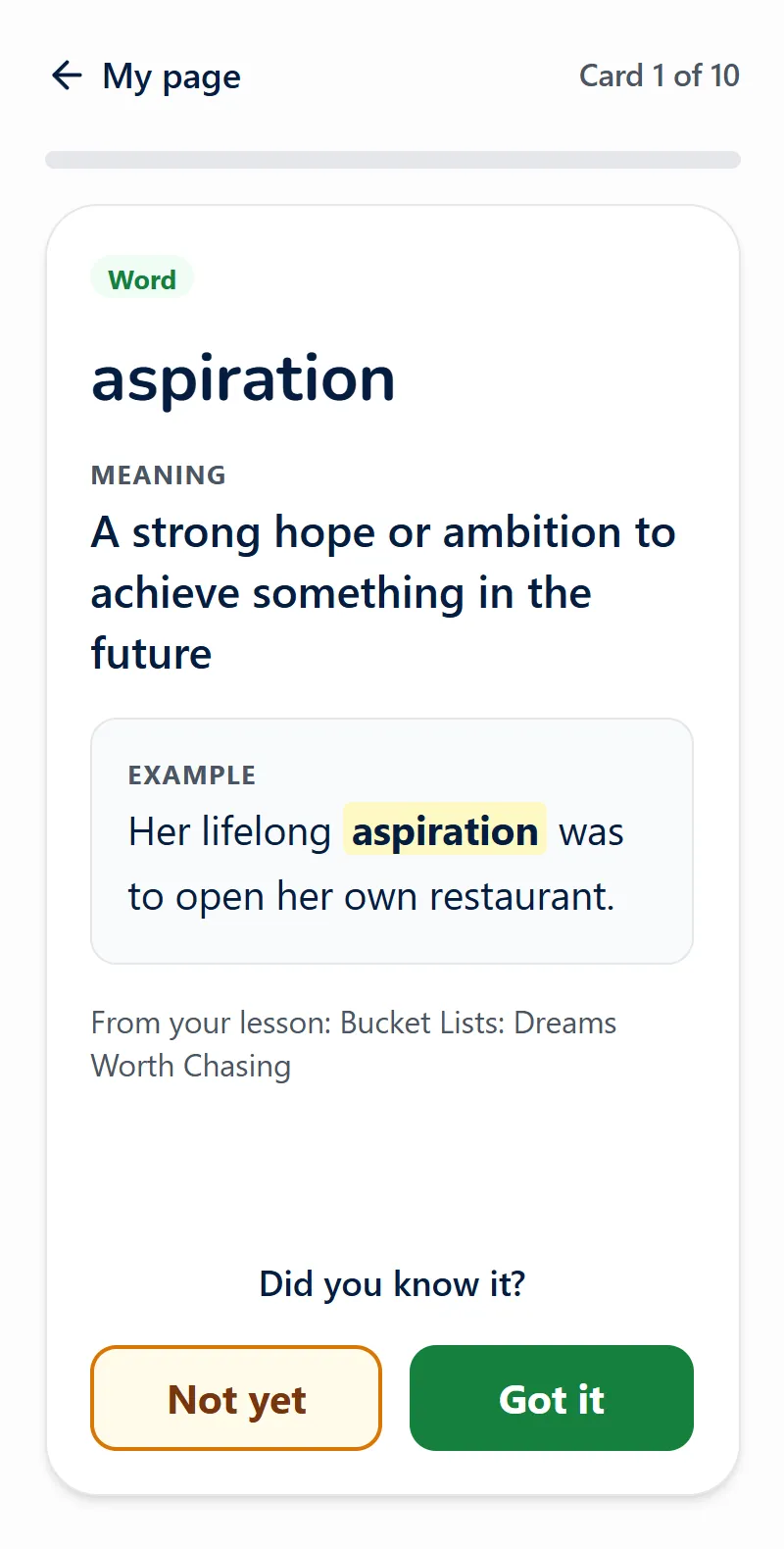
Use flashcards for a few minutes a day. Test yourself: look at the word and say what it means, then look at the meaning and say the word. Testing yourself makes your memory work harder than reading the list again, and that helps the word stay. This is called retrieval practice.
5. Meet it again in new situations
This is the step most learners miss. A word you see in one lesson and never again is soon forgotten. A word you meet again a week later, in a new text or a new question, stays. This is called spaced repetition. Read and listen about the same topics, so the same words come back.
6. Be consistent
Little and often is better than a lot once. For lessons, I recommend at least 1 hour a week, and about 3 hours a week is ideal. That builds a habit and helps you remember, without being so much that you get tired of it. 10 hours spread over a year won’t help much.
Let AI make you use your new words
AI is a great tool for this. Give it the words you are learning, and ask it to make you use them:
I am learning English. Here are five words I learned this week: [word 1], [word 2], [word 3], [word 4], [word 5]. Ask me one question at a time that makes me use one of these words in my answer. After each answer, tell me if I used the word correctly, correct my grammar, and give me a better example if I need one. Please use British English.
Speak your answers out loud if you can. For more ideas, see how to practise speaking English with AI.
How my lessons move words into long-term memory
In many English lessons, you learn a new word, use it once or twice, and it stays in your short-term memory. A few days later, it’s gone. My lessons are built to stop that.
My goal in every lesson is that you fully understand each new word: what it means, the context, and how to use it correctly. Then you use it yourself, in real conversation. After the lesson, flashcards and later lessons that use the word again move it from short-term to long-term memory. Step by step:
- Introduce. Each lesson has five key words for the topic. First I introduce them: how to say them, what they mean and how people really use them.
- Understand the use. You read a short text that uses the new words, and we look at the phrases around them.
- Use them. In the discussion, you use the new words to talk about your own work and life. I correct you and help you say it more naturally.
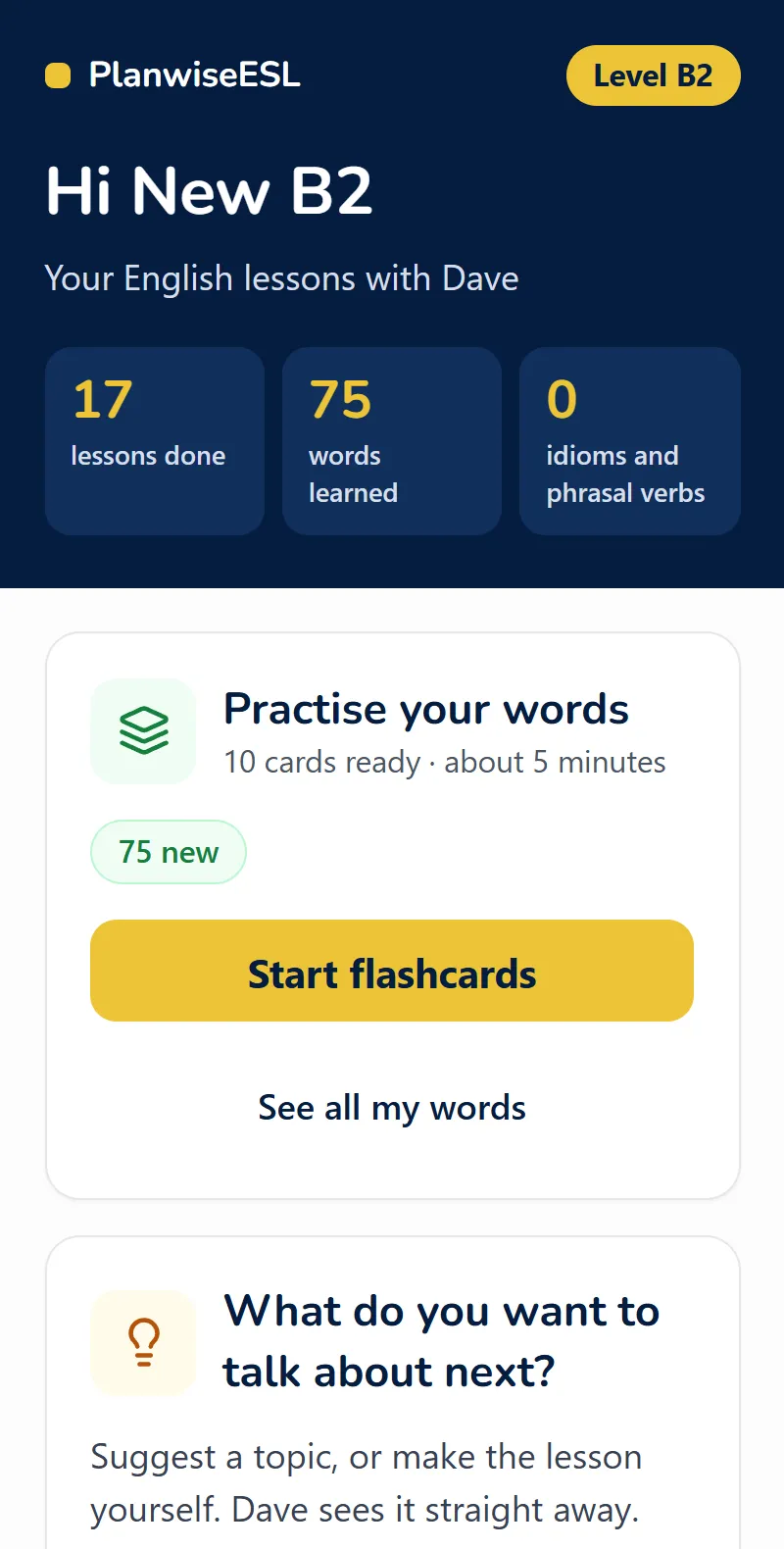
- Review. Short exercises and a quiz at the end. Then every word goes onto flashcards on your own private lesson page.
- Meet them again. Key words from earlier lessons come back in later lessons: in the reading, the discussion questions and more.
You can see this in my sample lessons: rapport and icebreaker are key words in both “The Art of Business Small Talk” and “Keeping the Conversation Going”.
My lessons are science-based. They follow two well-known findings from memory research: spaced repetition (you remember better when you meet something again after a gap) and retrieval practice (trying to remember something, as you do with flashcards, makes the memory stronger).
My lessons are private and one-to-one, from about $34 an hour, and the first 30-minute diagnostic is free. See how lessons work.
Questions about remembering English words
Why do I forget new English words so quickly?
Usually because the word only reached your short-term memory. You saw it once or twice, maybe in one lesson, and never met it again. To move a word into long-term memory, you need to understand it, use it, test yourself on it, and meet it again after a few days or weeks.
How many new English words should I learn a day?
Fewer than you think. It is better to really know five words than to half-know fifty. In my lessons, each topic has five key words, and you use them in a real discussion.
Why do I know a word but can’t use it when I speak?
Because recognising a word and using it are different skills. You recognise words when you read or listen. To use them, you need to say them yourself, many times, in real conversation. That is why speaking practice matters so much. See English conversation practice.
Are word lists and vocabulary apps a waste of time?
No, but they are only a start. They help you recognise a word. To remember it and use it, you also need to see it in use, say it yourself and meet it again later.
Is it better to learn words by topic?
Yes. Words about the same topic help each other, and you can use them together in one conversation. Every lesson I teach is a discussion topic with its key words, chosen for your job and your interests.
How do your lessons help me remember words?
Every lesson introduces five key words, shows you how people use them, and gets you using them in discussion. Then you review them with flashcards on your private lesson page, and key words come back in later lessons, so you meet them again and again. That moves them from short-term to long-term memory. My lessons are science-based: they use spaced repetition and retrieval practice.