Business Small Talk in English
Lesson: The Art of Business Small Talk
This is a lesson I teach to advanced learners who want to feel relaxed in the small talk before meetings, calls and client visits. Together we learn words like rapport, pleasantries and banter, and practise moving naturally from friendly chat to getting down to business.
In short: the key language in this lesson
Useful phrases
- Conceding a point before disagreeing: Admittedly, ___, but that doesn't change the fact that ___.
- Describing how relationships develop: What really changed things was when ___, and from then on ___.
- Giving practical advice with nuance: The trick is to ___ rather than ___, because ___.
Key words
- rapport:
- A feeling of trust and easy understanding between people
- icebreaker:
- A remark or activity that helps strangers start talking to each other
- banter:
- Friendly, playful teasing and joking conversation
- pleasantries:
- Polite, friendly remarks exchanged as a social formality
- camaraderie:
- A spirit of friendship and loyalty among a group of people
Idioms and phrasal verbs
- get down to business:
- stop the friendly talk and start the serious work
- open doors:
- create new opportunities for you
- set the tone:
- establish the mood or style that others follow
- lose the room:
- stop holding the audience's attention or support
This lesson is designed to be taught live, not studied alone. I create every lesson and teach it myself, one-to-one. In class, I guide you through each part, ask follow-up questions, correct your mistakes and help you say more.
Here you can see exactly what a lesson with me looks like. For my students, I build lessons like this around their own job and goals.
1 Warm-up
Before the lesson, chat casually about small talk itself — what it is, when it happens, and how it feels.
We start with a relaxed chat. I ask these questions, you answer freely, and I note useful language for later.
- When was the last time you had to make small talk with a stranger? How did it go?
- Do you enjoy chatting with people before a meeting starts, or does it feel like a waste of time?
- In your country, what do people usually talk about when they first meet — the weather, family, football?
- Have you ever been in a business situation where the conversation suddenly went silent? What did you do?
- Do you think small talk is a skill you can learn, or are some people just born chatty?
2 Key vocabulary
Before the reading, we go through 5 key words together: how to say them, what they mean, and how people really use them.

rapport noun
Pronunciation: /ra-POR/
A feeling of trust and easy understanding between people
- She built rapport with the client by asking about his weekend before the pitch.
- Good teachers establish rapport with their students in the first five minutes.
- There was an instant rapport between the two founders — they finished each other's sentences.
- I struggled to build any rapport with my new manager at first.
Common phrases build rapportestablish rapportan instant rapport
Word family rapport (noun)en rapport (phrase)
How to use it: Nearly always used with verbs like build, establish or develop. Note the silent final 't'. Common in business, teaching, therapy and sales contexts.
- Similar
- connection, chemistry, understanding
- Opposite
- distance, coldness
- Often used in
- business meetings, teaching, sales, interviews

icebreaker noun
Pronunciation: /ICE-bree-ker/
A remark or activity that helps strangers start talking to each other
- The trainer opened with a silly icebreaker that got everyone laughing within a minute.
- 'Terrible weather we're having' is the world's most predictable icebreaker.
- Every conference kicks off with some awkward icebreaker game — I dread them.
- A genuine question is a much better icebreaker than a rehearsed joke.
Common phrases an awkward icebreakeropen with an icebreakera quick icebreaker
Word family icebreaker (noun)break the ice (idiom)ice-breaking (adjective)
How to use it: Used for both spoken openers and structured games at events. Slightly informal but fully acceptable in professional settings.
- Similar
- conversation starter, opener, warm-up
- Opposite
- conversation killer, awkward silence
- Often used in
- conferences, training sessions, parties, interviews

banter noun
Pronunciation: /BAN-ter/
Friendly, playful teasing and joking conversation
- There was a lot of good-natured banter between the two rival sales teams.
- The office WhatsApp group is mostly banter and the occasional actual work message.
- He couldn't tell whether her comments were banter or genuine criticism.
- Friday meetings always descend into banter by the end.
Common phrases good-natured bantera bit of banterengage in banter
Word family banter (noun)banter (verb)bantering (adjective)
How to use it: Implies warmth and mutual consent — without those, the same words become insults. Very common in British English workplace culture.
- Similar
- teasing, badinage, raillery
- Opposite
- seriousness, hostility
- Often used in
- offices, sports teams, friendships, pubs

pleasantries noun
Pronunciation: /PLEZ-un-treez/
Polite, friendly remarks exchanged as a social formality
- We exchanged pleasantries about the holidays, then got straight down to the contract.
- After a few pleasantries, the chair called the meeting to order.
- He skipped the pleasantries entirely and launched into his complaint.
- There were warm pleasantries all round before the negotiations began.
Common phrases exchange pleasantriesa few pleasantriesskip the pleasantries
Word family pleasantries (noun, plural)pleasant (adjective)pleasantly (adverb)
How to use it: Almost always with 'exchange'. Slightly formal register — perfect for describing business interactions. The plural form is essential.
- Similar
- courtesies, formalities, niceties
- Opposite
- bluntness, discourtesy
- Often used in
- business meetings, diplomatic events, formal dinners

camaraderie noun
Pronunciation: /kah-mah-RAH-duh-ree/
A spirit of friendship and loyalty among a group of people
- Months of late nights on the project created real camaraderie in the team.
- There's a genuine camaraderie among the night-shift nurses.
- She missed the camaraderie of office life when she went freelance.
- The team's camaraderie showed in how freely they challenged each other's ideas.
Common phrases a sense of camaraderiegenuine camaraderieteam camaraderie
Word family camaraderie (noun)comrade (noun)comradely (adjective)
How to use it: Describes group feeling, not a one-to-one bond (that's rapport). Often used with 'a sense of'. Note the spelling — not 'comaraderie'.
- Similar
- fellowship, comradeship, team spirit
- Opposite
- distrust, isolation
- Often used in
- workplaces, sports teams, military, universities
3 Reading
A short article on why small talk, often dismissed as pointless, is actually doing serious work in professional life.
In class, you read the text aloud. I help with pronunciation and natural rhythm, and then we talk about it.
Why the Weather Matters More Than You Think
Ask anyone what they think of small talk and you'll usually get an eye-roll. It's dismissed as empty chatter — thirty seconds about the traffic or the rain before everyone gets down to business. But linguists who study workplace conversation have noticed something curious: those seemingly trivial exchanges are rarely trivial at all. They're doing invisible work.
The first thing small talk builds is rapport. When two colleagues discover they support the same football team, or both survived the same disastrous train journey, something shifts. They're no longer strangers negotiating a transaction; they're two people with something in common. Research suggests that teams with strong rapport make decisions faster and forgive each other's mistakes more readily.
This is why the humble icebreaker matters. A good one — a question, a joke, an observation about the room — gives everyone an easy on-ramp into conversation. The trick, seasoned networkers say, is to make it about the other person: 'How did you end up in this line of work?' opens far more doors than a comment about the catering.
Then there's banter, the playful teasing that signals comfort. In many offices, being able to give and take a joke is a quiet test of belonging. But banter travels badly across cultures: what reads as friendly sparring in one country can land as rudeness in another. The safe rule is to let the other person set the tone first.
Finally, don't underestimate the pleasantries themselves. Exchanging a few polite words before a negotiation measurably improves outcomes, because it reminds both sides that the person opposite is a person. Small talk, it turns out, isn't small at all — it's the foundation everything else stands on. Skip it, and you may save thirty seconds and lose the room.
4 Comprehension
We check what you understood from the reading. You explain your answer in your own words. (The answers are under each question.)
-
What does 'rapport' mean?
Show answer
A feeling of trust and easy understanding between people
Rapport describes the quality of a connection between two people — trust, ease and mutual understanding.
-
In which situation would you use an 'icebreaker'?
Show answer
When a group of strangers needs to start talking
An icebreaker is a remark or activity designed to get conversation going between people who don't know each other.
-
Which sentence uses 'banter' correctly?
Show answer
She enjoyed the friendly banter with her colleagues during lunch.
Banter is playful, friendly teasing — it's not a document, and it isn't used with 'a' as a countable noun in this meaning.
-
What does it mean to 'exchange pleasantries'?
Show answer
To make brief polite small talk as a social formality
Exchanging pleasantries means going through the polite ritual of greetings and light remarks before getting to the point.
-
What is 'camaraderie'?
Show answer
A spirit of friendship and loyalty within a group
Camaraderie is the collective feeling of trust and fellowship shared by a group, like a team that has been through a lot together.
5 Idioms and phrasal verbs
You find each expression in the reading and guess what it means. Then we practise using it to talk about your own life and work.
get down to business
From the readingIt's dismissed as empty chatter — thirty seconds about the traffic or the rain before everyone gets down to business.
What do you think it means? Show meaning
stop the friendly talk and start the serious work (similar: start working)
Example: We chatted for ten minutes, then the boss said, 'Right, let's get down to business.'
- The picture is literally sitting down at the desk to begin. Very common in meetings.
- Slightly informal but fine in any workplace conversation.
Your turn: When you meet a client, do you like to get down to business quickly, or do you enjoy the chat first?
open doors
From the reading'How did you end up in this line of work?' opens far more doors than a comment about the catering.
What do you think it means? Show meaning
create new opportunities for you (similar: create opportunities)
Example: Speaking good English opened a lot of doors for her in international companies.
- The picture: a door that was closed now opens, letting you into a new room — a new job, contact or chance.
- Often used with 'a lot of' or 'far more': 'it opened a lot of doors for me'.
Your turn: Has a conversation or a contact ever opened doors for you that you didn't expect?
set the tone
From the readingThe safe rule is to let the other person set the tone first.
What do you think it means? Show meaning
establish the mood or style that others follow (similar: create the mood)
Example: The manager's relaxed welcome set the tone for the whole meeting.
- From music: the first note decides the key. Whoever sets the tone, everyone else adjusts to it.
- Common pattern: 'set the tone for something'.
Your turn: When you join a new team or meet someone new, do you set the tone yourself, or wait and follow their lead?
lose the room
From the readingSkip it, and you may save thirty seconds and lose the room.
What do you think it means? Show meaning
stop holding the audience's attention or support (similar: lose the audience)
Example: He went on too long with the numbers and lost the room — people started checking their phones.
- 'The room' here means everyone present, the whole audience. Used for presentations, speeches, pitches.
- The opposite idea: 'win the room' or 'you had the room' when the audience is with you.
Your turn: Have you ever watched a speaker lose the room? What did they do wrong?
6 Sentence frames
Practice expressing and qualifying opinions about small talk and professional relationships.
We start with the simple frame and step up to longer, more natural sentences. You fill the gaps with your own ideas, and I help you sound more fluent.
Conceding a point before disagreeing
Grammar concession clauseshedging language
-
Simple
I see the point about ___, but ___.
Acknowledge the other view, then give yours.
Example answers
- I see the point about saving time, but small talk actually builds trust.
- I see the point about it feeling fake, but it's a useful social skill.
- I see the point about cultural differences, but politeness travels everywhere.
-
Stronger
Admittedly, ___, but that doesn't change the fact that ___.
Concede more fully, then push back with a stronger claim.
Example answers
- Admittedly, forced icebreakers can feel awkward, but that doesn't change the fact that they get people talking.
- Admittedly, not everyone enjoys banter, but that doesn't change the fact that it signals trust in most offices.
- Admittedly, skipping pleasantries saves time, but that doesn't change the fact that relationships drive business.
Describing how relationships develop
Grammar past tensesnarrative sequencing
-
Simple
At first ___, but after ___, we ___.
Describe a before-and-after shift in a relationship.
Example answers
- At first we only talked about work, but after the team dinner, we got on much better.
- At first my manager seemed cold, but after a few chats, we built real rapport.
- At first the meetings were tense, but after some banter, everyone relaxed.
-
Stronger
What really changed things was when ___, and from then on ___.
Identify a turning point and its consequence.
Example answers
- What really changed things was when he asked about my family, and from then on the conversations flowed.
- What really changed things was when the team survived that disastrous launch together, and from then on there was real camaraderie.
- What really changed things was when I stopped skipping the pleasantries and started actually listening to the answers.
Giving practical advice with nuance
Grammar conditional structuresmodal verbs for advice
-
Simple
If you want to ___, you should ___.
Simple conditional advice.
Example answers
- If you want to build rapport, you should ask people about themselves.
- If you want to avoid awkward silences, you should prepare a couple of icebreakers.
- If you want to sound natural, you should keep the pleasantries short.
-
Stronger
The trick is to ___ rather than ___, because ___.
Contrast a good approach with a bad one and justify it.
Example answers
- The trick is to ask open questions rather than yes-or-no ones, because they give the other person room to talk.
- The trick is to match the other person's energy rather than forcing your own, because banter only works when it's mutual.
- The trick is to be genuinely curious rather than performing friendliness, because people can tell the difference.
7 Fill in the blanks
A quick practice with the new words: you choose the right word for each gap.
Word box rapporticebreakerbanterpleasantriescamaraderie
Maya had just joined a new firm, and her first week was a whirlwind of introductions. On Monday morning, she exchanged a few 1 with the team over coffee — nothing deep, just comments about the weather and the weekend — but she noticed it made the atmosphere noticeably warmer. By Wednesday, she'd found her go-to 2: asking people how they'd ended up in their line of work. It worked every time; everyone has a story, and most people love telling it. Within a fortnight, she'd built genuine 3 with her closest colleagues, the kind where you can admit you're struggling with a project without feeling judged. There was even some playful 4 in the team's group chat — harmless teasing about whose coffee order was most ridiculous — which she took as a good sign that she'd been accepted. A month in, what struck her most was the 5: people covered for each other during crunch periods, shared credit generously, and actually seemed to enjoy working together. Maya concluded that all those 'wasted' minutes of small talk had been an investment all along.
Show answers
- pleasantries
- icebreaker
- rapport
- banter
- camaraderie
8 Sentence unscramble
You put the words in order and say the sentence out loud.
-
byweekendwithrapportbuiltaskingclienttheaboutshehis
Show answer
She built rapport with the client by asking about his weekend.
-
conversationintoeasyanwayicebreakergivesaeveryonegood
Show answer
A good icebreaker gives everyone an easy way into conversation.
-
monthsthecamaraderieofcreatedteaminreallatenights
Show answer
Months of late nights created real camaraderie in the team.
9 Discussion
The main speaking part of the lesson. We discuss each question together, and you use the new words and sentence frames. I ask follow-up questions and correct your mistakes as we go.
-
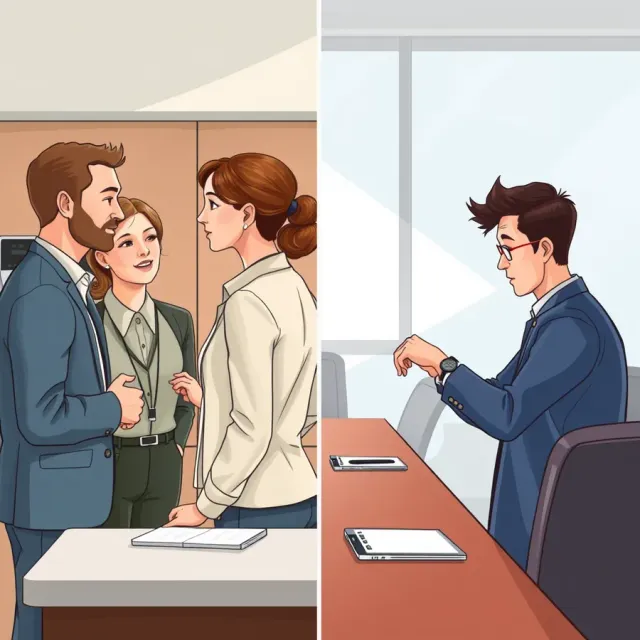
The article argues that small talk does 'invisible work' — building trust before any real business happens. Some people love this ritual; others find it exhausting and fake, especially those who'd rather dive straight into the agenda.
Do you think small talk is a genuine skill worth mastering, or just a performance people put on? Where do you draw the line?
-

Think about a working relationship that started cold — a client, a colleague, a manager — and warmed up over time. Often there's a specific moment that changed everything: a shared joke, a crisis survived together, a moment of unexpected honesty.
Can you think of a time when your relationship with a colleague or client suddenly shifted? What exactly changed it?
-
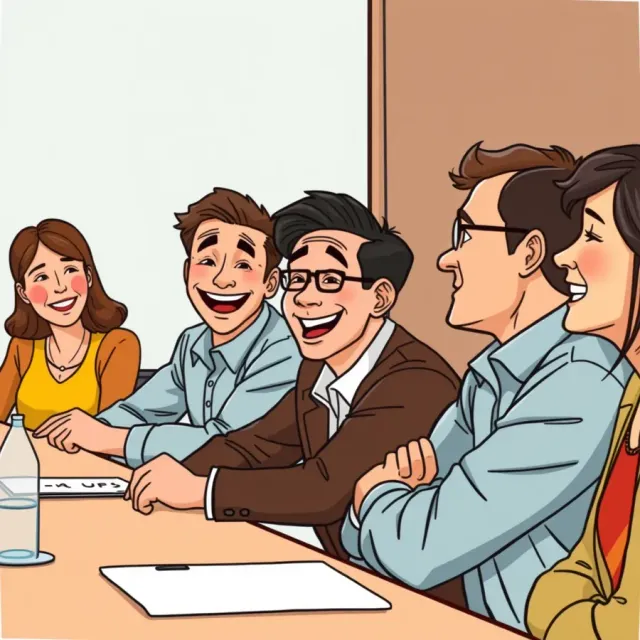
Banter is a quiet test of belonging in many workplaces — but it travels badly. A joke that lands well in one culture can cause real offence in another, and international teams have to navigate this constantly.
How does humour work in the workplaces you've known? Would you risk banter with someone from a very different culture, or play it safe?
-

Remote work has quietly killed the corridor conversation. Video calls start on the hour and end on the dot, and the five minutes of pleasantries that used to happen naturally now have to be scheduled — or skipped entirely.
Do you think remote work is destroying small talk, and if so, what are we losing? How could teams replace it?
-
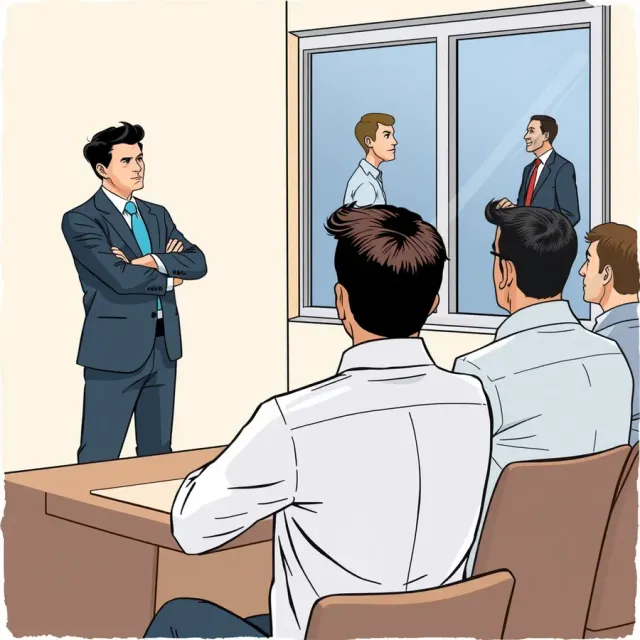
Imagine you're coaching a talented professional who's brilliant at their job but terrible at the social side: they skip the pleasantries, misread the room, and wonder why deals keep slipping away to more likeable competitors.
What advice would you give them? Is there such a thing as being too good at your job to need small talk?
10 Quiz
A short review at the end of the lesson to check what you remember.
-
Which verb collocates most naturally with 'rapport'?
Show answer
build
We build, establish or develop rapport — 'perform rapport' and 'install rapport' aren't natural English.
-
'Pleasantries' is usually used in the singular form.
Show answer
False
In this meaning, 'pleasantries' is almost always plural: 'exchange pleasantries', 'a few pleasantries'.
-
What's the difference between 'rapport' and 'camaraderie'?
Show answer
Rapport is between two people; camaraderie is a group feeling
Rapport describes a one-to-one connection, while camaraderie describes the shared spirit of a whole group.
-
An 'icebreaker' is something you say or do to end a conversation politely.
Show answer
False
An icebreaker starts conversation between strangers — it breaks the ice, it doesn't close the door.
-
Which phrase best completes this sentence: 'We ______ a few pleasantries, then got down to business.'
Show answer
exchanged
'Exchange pleasantries' is the fixed collocation — you exchange pleasantries, then move on to the real conversation.
-
If a speaker 'loses the room', what has happened?
Show answer
The audience has stopped listening to them
'Lose the room' means the audience stops paying attention or supporting you — you no longer have them with you.
Lesson created with PlanwiseESL.
Useful for: Business English lessons · English for sales professionals
More sample lessons
Diplomatic English: How to Disagree Politely
Learn how to disagree diplomatically in English: soften your words, push back politely and find common ground. A B2 speaking lesson I teach live.
See the lesson → Level C1Thinking in English: Ditching the Mental Translator
Stop translating in your head when you speak English. Learn why it happens and how English becomes a reflex. A C1 speaking lesson I teach live.
See the lesson → Level B2When Things Break Down: Explaining a Technical Problem
A B2 English lesson for engineers and IT, as I teach it one-to-one: glitches, workarounds and malfunctions, with a reading, frames and discussion.
See the lesson →All sample lessons: Talk About the Pros and Cons of International Aid in English · Words to Describe Inequality in English · Health and Fitness Vocabulary in English · Vocabulary to Talk About Films in English · Vocabulary to Talk About Money in English · Vocabulary to Talk About the Environment in English · Words to Describe a Leader in English · Handling Price Objections in English · How to Keep a Conversation Going in English · Patient Handover English for Doctors and Nurses · Presenting Monthly Results in English · Understanding Contracts in Plain English · How to Answer Questions After a Presentation in English · How to Talk About Your Career Goals and Leadership in an Interview · Vocabulary to Talk About Geopolitics in English · What British Colleagues Really Mean: Polite, Indirect English at Work · Vocabulary to Talk About AI in English