How to Answer Questions After a Presentation in English
Lesson: Handling Questions After a Presentation
This is a lesson I teach to professionals, researchers and students who can give a prepared talk but freeze when the questions start. Together we learn words like clarify, rephrase and acknowledge, and phrases like “I’ll get back to you on that”, then discuss how to stay calm and honest when a question puts you on the spot.
In short: the key language in this lesson
Useful phrases
- Asking someone to make their point clearer: Sorry, I'm not sure I follow. Could you clarify what you mean by ___ ?
- Supporting your answers with reasons and proof: In my experience, ___. For example, ___.
- Handling questions you can't answer: I don't have that information with me, but I'll get back to you after the meeting.
Key words
- clarify:
- to make something easier to understand by explaining it more
- rephrase:
- to say the same thing again using different words
- findings:
- the results and conclusions of a study, report or project
- evidence:
- facts or things that show something is true
- acknowledge:
- to show you have noticed or accepted something
Idioms and phrasal verbs
- get back to (someone):
- contact someone later with the answer
- win (someone) over:
- make someone like or support you
- make up (an answer):
- invent something that isn't true
- put someone on the spot:
- ask someone a difficult question suddenly
This lesson is designed to be taught live, not studied alone. I create every lesson and teach it myself, one-to-one. In class, I guide you through each part, ask follow-up questions, correct your mistakes and help you say more.
Here you can see exactly what a lesson with me looks like. For my students, I build lessons like this around their own job and goals.
1 Warm-up
Talk about your experiences with presentations and question time, before we look at some useful language for answering questions.
We start with a relaxed chat. I ask these questions, you answer freely, and I note useful language for later.
- When was the last time you gave a presentation or spoke in front of people? How did it go?
- Do you enjoy answering questions after a talk, or does it make you nervous? Why?
- Have you ever been asked a question you couldn't answer? What did you do?
- What makes a speaker's answer sound good to you?
- If you could give one piece of advice to someone before their Q&A, what would it be?
2 Key vocabulary
Before the reading, we go through 5 key words together: how to say them, what they mean, and how people really use them.

clarify verb
Pronunciation: /KLAR-ih-fy/
to make something easier to understand by explaining it more
- Could you clarify what you meant by 'flexible hours'?
- Let me clarify: the deadline is Friday, not Monday.
- She asked the manager to clarify the new rules.
- I'd like to clarify one point from my last email.
Common phrases clarify a pointclarify what you meanask for clarification
Word family clarification (noun)clear (adjective)
How to use it: Use it when something is confusing and needs a better explanation. Common in polite requests: 'Could you clarify...?' It is a normal verb, so it is not split.
- Similar
- explain, make clear, spell out
- Opposite
- confuse, muddle
- Often used in
- meetings, presentations, emails
rephrase verb
Pronunciation: /ree-FRAYZ/
to say the same thing again using different words
- Let me rephrase that: we need more time, not more money.
- Could you rephrase the question? I'm not sure I follow.
- He rephrased his answer to make it shorter.
- I'll rephrase it in simpler terms.
Common phrases rephrase the questionrephrase that in simple termslet me rephrase
Word family phrase (noun)rephrasing (noun)
How to use it: Very useful when you or someone else was not understood. 'Let me rephrase that' is a natural way to fix your own sentence. Regular verb, not split.
- Similar
- reword, restate, put differently
- Often used in
- classrooms, presentations, customer service

findings noun (usually plural)
Pronunciation: /FYND-ingz/
the results and conclusions of a study, report or project
- The findings showed that most customers prefer paying online.
- She presented her findings at the conference.
- The report's findings surprised the whole team.
- We'll share our findings next month.
Common phrases present your findingskey findingsthe findings show that
Word family find (verb)finding (noun, single result)
How to use it: Almost always plural when talking about research or a report. Use with verbs like present, share, publish or support.
- Similar
- results, conclusions, outcomes
- Often used in
- conferences, reports, team meetings

evidence noun (uncountable)
Pronunciation: /EV-ih-denss/
facts or things that show something is true
- There's strong evidence that exercise improves sleep.
- Can you give me any evidence for that claim?
- The evidence suggests we should change our plan.
- Without evidence, it's just an opinion.
Common phrases strong evidenceprovide evidenceevidence suggests
Word family evident (adjective)evidently (adverb)
How to use it: Uncountable: say 'a piece of evidence' or 'some evidence', never 'evidences'. Often used with strong, clear or little.
- Similar
- proof, support, facts
- Opposite
- guess, opinion
- Often used in
- debates, courtrooms, presentations

acknowledge verb
Pronunciation: /ak-NOL-ij/
to show you have noticed or accepted something
- She acknowledged the mistake and promised to fix it.
- He acknowledged that the plan had weaknesses.
- Please acknowledge my email when you can.
- It's good to acknowledge a fair criticism.
Common phrases acknowledge a mistakeacknowledge a problemacknowledge someone's point
Word family acknowledgement (noun)
How to use it: Often followed by 'that' plus a clause. In Q&A, acknowledging a criticism before answering makes you sound fair and confident. Regular verb, not split.
- Similar
- admit, recognise, accept
- Opposite
- deny, ignore
- Often used in
- presentations, workplace, customer service
3 Reading
A short article about what happens when the talk ends and the questions begin.
In class, you read the text aloud. I help with pronunciation and natural rhythm, and then we talk about it.
The Moment Everyone Dreads
Maya had prepared her presentation for weeks. Her slides were clear, her timing was perfect, and she felt confident. Then she finished speaking, looked up, and heard the first question. Her mind went completely blank. Many people say the question time after a talk is the scariest part, and Maya now agrees.
The problem is that questions are unpredictable. Someone might ask you to clarify a point you made quickly, or to rephrase your main idea in simpler words. A good speaker stays calm and treats each question as a chance to explain, not as an attack. That change of attitude makes a huge difference.
There are useful habits you can learn. First, listen to the whole question before you answer. Then repeat it in your own words, so everyone hears it and you get a few seconds to think. If you don't know the answer, be honest and say you'll get back to them later. People respect honesty far more than a made-up answer.
It also helps to support your points with evidence. If you present findings from a project or some research, mention where they come from. And when someone points out a weakness in your argument, acknowledge it politely instead of ignoring it. Saying 'That's a fair point' often wins the room over.
In the end, question time is not a test you can fail. It's a conversation, and even difficult questions give you a chance to show what you know. Maya's second presentation went much better. She still felt nervous, but this time she saw the questions as help, not danger.
4 Comprehension
We check what you understood from the reading. You explain your answer in your own words. (The answers are under each question.)
-
What does 'clarify' mean?
Show answer
To make something easier to understand by explaining it more
Clarify means to make a confusing point clear, often by explaining it again in a better way.
-
Which word best completes the sentence? 'I didn't understand the question, so I asked her to ___ it.'
Show answer
rephrase
Rephrase means to say the same thing in different words, which is exactly what you want when a question is unclear.
-
What does 'findings' mean in this sentence: 'Her findings surprised the whole team.'?
Show answer
The results and conclusions of her work
Findings are the results or conclusions you get from a study, project or report.
-
In which situation would you use the word 'evidence'?
Show answer
When you want to show that your idea is true with facts
Evidence is facts or information that support a claim and show it is true.
-
What does 'acknowledge' mean?
Show answer
To show you have noticed or accepted something
Acknowledge means to recognise or accept something, such as a mistake or a fair criticism.
5 Idioms and phrasal verbs
You find each expression in the reading and guess what it means. Then we practise using it to talk about your own life and work.
get back to (someone)
From the readingIf you don't know the answer, be honest and say you'll get back to you later.
What do you think it means? Show meaning
contact someone later with the answer (similar: reply later)
Example: I'm not sure about the price, but I'll get back to you tomorrow.
- 'back' suggests returning to the person later — you go away, then come back with an answer.
- Very common in work emails: 'I'll get back to you on that.'
Your turn: When was the last time you promised to get back to someone? Did you actually do it?
win (someone) over
From the readingSaying 'That's a fair point' often wins the room over.
What do you think it means? Show meaning
make someone like or support you (similar: convince)
Example: Her honest answer won over even the toughest questioner.
- 'Over' suggests moving someone from the other side to your side.
- You can win over a person or a whole group: 'win the audience over'.
Your turn: Have you ever had to win over someone who disagreed with you? How did you do it?
make up (an answer)
From the readingPeople respect honesty far more than a made-up answer.
What do you think it means? Show meaning
invent something that isn't true (similar: invent)
Example: He didn't know the date, so he just made up an answer.
- 'Up' here means creating something from nothing — like making up a story.
- As an adjective before a noun, it's hyphenated: 'a made-up excuse'.
Your turn: Have you ever made up an answer because you didn't want to say 'I don't know'? What happened?
put someone on the spot
What do you think it means? Show meaning
ask someone a difficult question suddenly (similar: make someone answer right away)
Example: The boss put me on the spot by asking for the numbers in front of everyone.
- The picture is standing in one exact spot with everyone watching you.
- Common in office talk and the news: 'The reporter put him on the spot.'
Your turn: When was the last time someone put you on the spot? What did you say?
6 Sentence frames
Practise expressing ideas about answering questions confidently after a talk.
We start with the simple frame and step up to longer, more natural sentences. You fill the gaps with your own ideas, and I help you sound more fluent.
Asking someone to make their point clearer
Grammar polite question forms with could/wouldembedded questions
-
Simple
Could you ___ , please?
Add a verb like repeat that, clarify the last point, or speak more slowly.
Example answers
- Could you repeat that, please?
- Could you clarify the last point, please?
- Could you speak more slowly, please?
-
Stronger
Sorry, I'm not sure I follow. Could you clarify what you mean by ___ ?
Name the exact word or idea that confused you.
Example answers
- Sorry, I'm not sure I follow. Could you clarify what you mean by 'flexible'?
- Sorry, I'm not sure I follow. Could you clarify what you mean by the second step?
- Sorry, I'm not sure I follow. Could you clarify what you mean by 'long-term goals'?
Supporting your answers with reasons and proof
Grammar because and since clausespresenting results
-
Simple
I think ___ because ___.
Give your opinion and one simple reason.
Example answers
- I think practice matters most because you can't learn speaking from books alone.
- I think small teams work better because it's easier to share ideas.
- I think mornings are best because I have more energy then.
-
Stronger
In my experience, ___. For example, ___.
Support your point with a personal example.
Example answers
- In my experience, questions get easier with practice. For example, after my third presentation I stopped panicking.
- In my experience, people respect honesty. For example, once I admitted I didn't know and the audience was very kind.
- In my experience, short answers work best. For example, my best answer ever took about thirty seconds.
Handling questions you can't answer
Grammar will for promisesconditional sentences
-
Simple
That's a good question. I don't know, but I can ___ .
Finish with find out, check, or ask my colleague.
Example answers
- That's a good question. I don't know, but I can find out.
- That's a good question. I don't know, but I can check with my manager.
- That's a good question. I don't know, but I can ask my colleague tomorrow.
-
Stronger
I don't have that information with me, but I'll get back to you after the meeting.
Promise to follow up later.
Example answers
- I don't have that information with me, but I'll get back to you after the meeting.
- I don't have the exact numbers with me, but I'll get back to you by Friday.
- I don't have that information with me, but I'll get back to you once I've checked.
7 Fill in the blanks
A quick practice with the new words: you choose the right word for each gap.
Word box clarifyrephraselimitationacknowledgefindings
After Sofia's talk, the first question came from a man at the back. He asked her to 1 one of her slides, so she took a breath and 2d the main idea in simpler words. Next, a woman pointed out a 3 in the study: it only included people from one city. Sofia 4d this fairly and said future research would cover more areas. She then shared the key 5 again, this time with clear evidence for each one. By the end, the audience was smiling, and one listener even asked a friendly follow-up question about her next project.
Show answers
- clarify
- rephrase
- limitation
- acknowledge
- findings
8 Sentence unscramble
You put the words in order and say the sentence out loud.
-
?youyouwhatclarifyCouldbymeanthat
Show answer
Could you clarify what you mean by that?
-
strongwithsupportedevidenceher.findingsShe
Show answer
She supported her findings with strong evidence.
-
I'llgetbackdon'tItotheyoubut.tomorrowknowanswer
Show answer
I don't know the answer but I'll get back to you tomorrow.
9 Discussion
The main speaking part of the lesson. We discuss each question together, and you use the new words and sentence frames. I ask follow-up questions and correct your mistakes as we go.
-

Imagine you've just finished a presentation to twenty people. Your slides went well, but now hands are going up. Some speakers love this moment; others count the seconds until it ends.
How do you feel in the last five minutes of a presentation, when the questions start? Has that feeling changed over time?
-
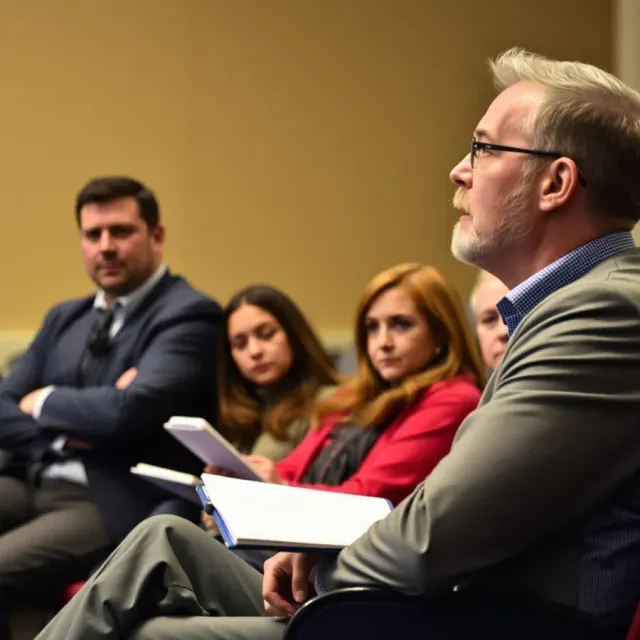
Someone asks you a question and you have no idea of the answer. You could invent something, say you'll find out, or turn the question back to the audience.
What would you actually do in that moment? Do you think saying 'I don't know' makes a speaker look weak or honest?
-
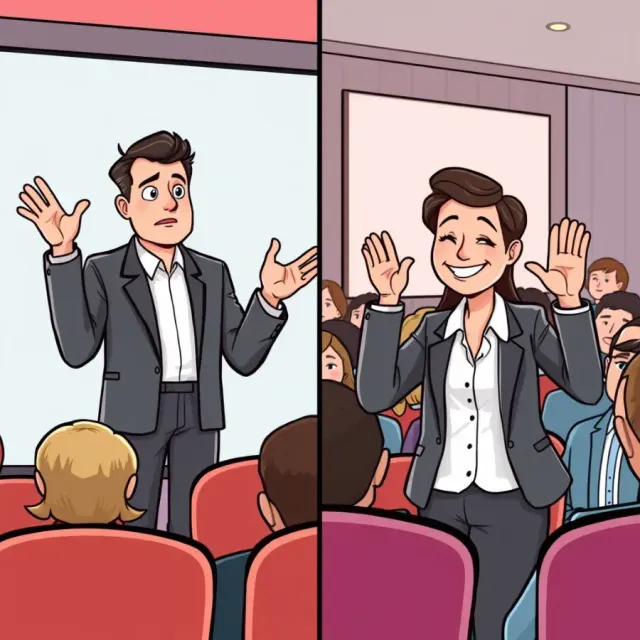
In some cultures, questioners are very direct and even challenge the speaker strongly. In others, questions are gentle and polite. Both styles exist around the world.
Are questioners in your country or workplace direct or polite? Which style do you find easier to answer, and why?
-

A colleague gives a talk and presents findings from a customer survey. A listener says, 'That's just one survey. How do we know it's true?' The colleague could get defensive, or acknowledge the point and explain the evidence behind it.
If you were your colleague, how would you answer? What's the best way to respond when someone attacks your evidence?
-

Some people say the best speakers are born, not made: either you're confident in front of a crowd or you're not. Others believe Q&A skills are just habits anyone can learn, like repeating the question or promising to get back to you.
Do you think answering questions is a natural talent or a learnable skill? What's one habit you'd like to build?
10 Quiz
A short review at the end of the lesson to check what you remember.
-
Which word best completes the sentence? 'The report's main ___ was that younger customers shop mostly on their phones.'
Show answer
finding
A finding is a result or conclusion from a study or report. 'Evidence' is the support for a claim, not the conclusion itself.
-
True or false? You can say 'three evidences' when talking about facts that support your idea.
Show answer
False
Evidence is uncountable. Say 'three pieces of evidence' or 'some evidence', never 'evidences'.
-
What does 'clarify' mean in this sentence: 'Could you clarify the second point? I'm not sure I follow.'
Show answer
Explain it again more clearly
Clarify means to make something easier to understand by explaining it better.
-
Which phrase means 'to say the same thing again using different words'?
Show answer
rephrase
Rephrase means to express the same idea in different words, often to make it clearer.
-
Why is it a good idea to acknowledge a criticism before answering it?
Show answer
Because it shows you heard the point and makes you sound fair and confident
Acknowledging a fair point shows you are listening and honest, which usually wins the audience over.
-
If a speaker says 'I'll get back to you on that', what do they mean?
Show answer
They will contact you later with the answer
'Get back to someone' means to contact them later, usually with the information they asked for.
Lesson created with PlanwiseESL.
Useful for: Business English lessons · English for IT and tech professionals
More sample lessons
What British Colleagues Really Mean: Polite, Indirect English at Work
Why “not bad” means good and “would you mind…?” means now: polite, indirect British English at work. A B2 lesson I teach live, one-to-one.
See the lesson → Level B2AI Assistants: Friend or Foe?
Learn words to talk about AI, like versatile, indispensable and ethical, and use them to discuss AI at work and in life. A B2 lesson I teach one-to-one.
See the lesson → Level C1The Art of Business Small Talk
Learn the words for business small talk, like rapport, pleasantries and banter, and practise the chat before a meeting starts. A C1 lesson I teach live.
See the lesson →All sample lessons: How to Talk About Your Career Goals and Leadership in an Interview · Vocabulary to Talk About Geopolitics in English · How to Disagree Diplomatically in English · Talk About the Pros and Cons of International Aid in English · How to Stop Translating in Your Head When You Speak English · Words to Describe Inequality in English · Health and Fitness Vocabulary in English · Vocabulary to Talk About Films in English · Vocabulary to Talk About Money in English · Vocabulary to Talk About the Environment in English · Words to Describe a Leader in English · Explaining a Technical Problem in English · Handling Price Objections in English · How to Keep a Conversation Going in English · Patient Handover English for Doctors and Nurses · Presenting Monthly Results in English · Understanding Contracts in Plain English